
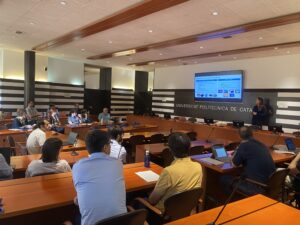
 On September 29, 2023, the Barcelona Supercomputing Center (BSC) hosted the 4th edition of the HPC Combustion Workshop (HPCCOMB), once again becoming a key meeting point for the Spanish combustion research community. The event brought together researchers and experts from across Spain and beyond to discuss the role of High-Performance Computing (HPC) in the modeling of combustion systems.
The workshop opened with a keynote lecture by Professor Mario Sánchez Sanz from the Fluid Mechanics Department at Universidad Carlos III de Madrid. His talk, titled “Theoretical and experimental analysis of flames propagating in slender channels”, focused on the unique challenges posed by flame propagation in confined geometries, such as those found in hydrogen fuel cell systems. Drawing on theoretical, numerical, and experimental insights, Sánchez Sanz explored how hydrogen-air mixtures can form distinct propagation regimes, even in sub-millimetric gaps, highlighting the critical role of heat loss and fuel diffusivity.
Two outstanding plenary speakers brought international perspectives to the workshop.
Professor Aimee Morgans, from the Department of Mechanical Engineering at Imperial College London, presented “Simulating dancing flames for thermoacoustic instability”. Her talk addressed the complex feedback between unsteady heat release and acoustic waves in combustors, a phenomenon that can lead to destructive thermoacoustic instabilities. She also introduced advanced multi-scale simulation methods that aim to predict and prevent such instabilities in next-generation, low-emission engines.
Dr. Ivan Langella, Assistant Professor in Sustainable Aircraft Propulsion at TU Delft, delivered a plenary session titled “Highly strained hydrogen flames: challenges and perspectives”. He discussed the potential of hydrogen as a clean energy carrier, and the challenges its combustion poses due to its high reactivity and tendency for flashback. Langella highlighted how flame behavior under extreme strain could lead to stable, ultra-low NOx combustion, opening new avenues for green propulsion systems.
The workshop featured 7 contributed presentations and 9 flash talks, covering a wide range of research in numerical combustion. Topics included turbulence–chemistry interactions, multi-phase combustion, large-eddy simulations (LES), and advances in physical modeling techniques.
As combustion modeling continues to require increasingly sophisticated computational resources, events like the HPC Combustion Workshop remain essential for advancing the field. With a strong turnout and engaging discussions, the 2023 edition reaffirmed the workshop’s role as a reference point for Spain’s HPC combustion community.